Navigating the Emirates’ property market? Discover how to pick the best Real Estate CRM Dubai brokers use to manage off-plan leads and secondary sales efficiently.
Table of Contents
If you’ve ever tried to manage a dozen off-plan leads while stuck in traffic on Sheikh Zayed Road, you know that the Dubai property market is unlike any other. It’s fast, it’s loud, and it waits for no one. One minute you’re discussing a luxury penthouse in Palm Jumeirah, and the next, you’re chasing a developer for the latest payment plan. In this environment, your smartphone is basically an extension of your arm, but the software running on it is what actually determines your commission check at the end of the month.
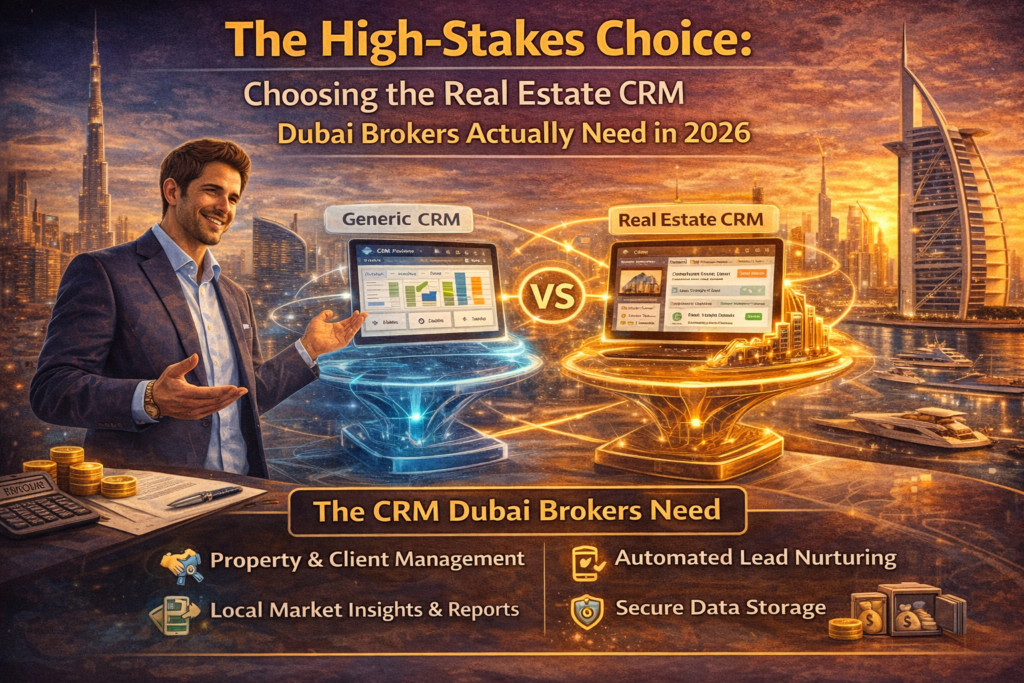
The reality of the 2026 market is that generic tools just don’t cut it anymore. A Real Estate CRM Dubai professionals choose must handle specific local nuances—from RERA compliance to direct portal integrations with Property Finder and Bayut. If you’re still using a spreadsheet or a basic global CRM that doesn’t understand what a “Noqodi” payment is, you’re fighting a losing battle. Let’s talk about how to find a system that actually works as hard as you do.
Why the Emirates Market Requires Specialized Tech
The Dubai property landscape is a unique beast. We have a massive “off-plan” sector where we aren’t just selling a home; we’re selling a vision of a project that might not be finished for three years. This requires a specific type of lead nurturing. You need to track developer announcements, construction updates, and shifting floor plans.
A specialized Real Estate CRM Dubai brokers rely on will have these developer feeds baked right in. It’s about more than just a list of names. It’s about having a “single source of truth” where you can see which units are still available in a Burj Khalifa district launch without having to call five different people. When the market moves this fast, the lag time of a manual search is a deal-killer.
Essential Features for the Modern Dubai Broker
When you’re shopping around for a new platform, it’s easy to get blinded by fancy charts and colorful buttons. But when you’re in the trenches, you need functionality. Here is what actually matters for a Real Estate CRM Dubai enterprise to stay profitable.
1. Seamless Portal Integration
If your CRM doesn’t automatically pull leads from the major portals and push your listings back out to them, delete it. You don’t have time for manual data entry. You want a system that “talks” to Bayut, Property Finder, and Dubizzle in real-time. This ensures your listing agreement details are consistent everywhere and that your “Lead Response Time” is measured in seconds, not hours.
2. Lead Scoring for High-Value Investors
Not all leads are created equal. In a city where “Whale” investors are common, your Real Estate CRM Dubai software needs to help you prioritize. If a lead has viewed three luxury villas in Emirates Hills on your site, the system should flag them as high-priority. It’s about predictive analytics—knowing who is ready to buy before they even tell you.
3. Native WhatsApp Integration
In Dubai, WhatsApp isn’t just a messaging app; it’s the primary way business gets done. A professional Real Estate CRM Dubai setup must allow you to message clients directly from the contact record and, more importantly, log that conversation. This protects the agency’s data and ensures that if a broker leaves, the history of that relationship stays with the firm.
Navigating RERA and Legal Compliance
Compliance isn’t the most exciting topic, but in the UAE, it’s the most important. The Dubai Land Department (DLD) and the Real Estate Regulatory Agency (RERA) have strict rules about how properties are marketed and how data is handled.
Using a Real Estate CRM Dubai brokers trust means having a system that generates Trakheesi permits and handles the “Form A” and “Form B” digital signatures without a hitch. If your software makes compliance a chore, your team will find ways to skip steps, and that’s when the fines start rolling in. According to the latest guidelines on Wikipedia’s Real Estate in Dubai page, digital transparency is now a mandatory pillar of the local industry.
Managing the Off-Plan vs. Secondary Market Split
Most brokers in the city dabble in both, but they require different workflows. Secondary sales are all about the comparable market analysis (CMA). You need to show a seller exactly what the apartment next door sold for last week.
Off-plan sales, however, are about the “drip.” You need a Real Estate CRM Dubai framework that can automate follow-ups over a 24-month period. It should remind you to send a WhatsApp to your client when the developer hits the 50% construction milestone. This keeps the relationship warm for when the next project launches in Dubai South or Emaar Beachfront.
The Impact of Mobile Accessibility on Sales Velocity
We are rarely at our desks. Whether you’re at a viewing in Dubai Marina or meeting a client for coffee in DIFC, your CRM needs to be in your pocket. A Real Estate CRM Dubai mobile app should allow you to snap a photo of a new listing, upload it, and have the draft ready for approval before you’ve even left the building.
The “velocity” of a deal in this city is breakneck. If a client wants to sign an MOU (Memorandum of Understanding) right now, you need to be able to generate it on your tablet. If you have to go back to the office to “run the numbers,” that client will find another broker who can do it on the spot.
Identifying Your “Ideal Investor Profile”
The data you collect in your CRM is a goldmine. Over time, a robust Real Estate CRM Dubai setup will show you patterns. You might realize that your best-performing leads for Jumeirah Village Circle (JVC) all come from a specific demographic or age group.
Once you have this data, you can stop “spraying and praying” with your marketing budget. You can focus your residential real estate ads on the exact people most likely to convert. This lowers your cost per lead and significantly increases your profit margins. Insights from the Dubai Land Department show that data-driven agencies are consistently outperforming traditional ones in terms of transaction volume.
Integrating With Your Total Tech Stack
Your CRM shouldn’t be a lonely island. To get the most out of your Real Estate CRM Dubai investment, it needs to talk to your accounting software, your email marketing tools, and your property management system.
Imagine a world where a “Closed-Won” deal in your CRM automatically triggers an invoice for the commission and sets up a welcome sequence for the new owner. This is the level of workflow automation that allows a small agency to compete with the giants. It removes the administrative burden from your brokers, letting them do what they do best: sell.
Choosing Cloud-Based vs. On-Premise
In 2026, the debate is largely over: cloud-based is the only way to go. It offers better security, easier updates, and the “work from anywhere” flexibility that the Dubai market demands. However, you must ensure that the Real Estate CRM Dubai provider you choose has servers that comply with UAE data residency laws. Protecting your real estate portfolio data is not just a good business practice; it’s a legal requirement.
Training and Adoption: The Human Factor
You can buy the most expensive, feature-rich Real Estate CRM Dubai on the market, but if your brokers find it too complicated, they won’t use it. I’ve seen agencies spend a fortune on tech only to have their team go back to using “Notes” on their iPhones.
When selecting a system, look at the user interface. Is it intuitive? Does it feel like it was built by someone who has actually sold a house? Adoption is the only true measure of ROI. If the team doesn’t log their calls and update their escrow statuses, the reports you get at the end of the month will be worthless.
Summary of the Selection Process
To wrap it up, don’t settle for a generic solution. The Dubai market is too specific and too competitive for “average” tools.
- Look for local portal integrations.
- Prioritize mobile-first workflows.
- Ensure RERA and DLD compliance is built-in.
- Demand native WhatsApp and lead-scoring features.
Choosing the right Real Estate CRM Dubai brokers use is a strategic decision that will define your agency’s growth for the next five years. It’s the foundation upon which your sales machine is built.
FAQ Section
1. What is the average cost of a Real Estate CRM Dubai agencies use? Prices vary based on the number of users and features, but typically, you can expect to pay between AED 150 to AED 500 per user per month. Many providers also offer tiered pricing for larger teams or enterprise-level agencies.
2. Can I migrate my old data into a new Real Estate CRM Dubai system? Most professional providers offer data migration services. It is crucial to clean your data first to ensure you aren’t importing duplicates or “dead” leads into your new, efficient Real Estate CRM Dubai environment.
3. Does the CRM help with Property Finder and Bayut rankings? While the CRM itself doesn’t directly change your ranking, it ensures that your listings are high-quality, frequently updated, and RERA-compliant. Better listing quality scores on portals lead to higher visibility and more leads.
4. Is WhatsApp integration legal for real estate in Dubai? Yes, but it must be handled professionally. Using a Real Estate CRM Dubai with integrated WhatsApp ensures that the business maintains a record of the conversation, which is important for dispute resolution and maintaining professional standards.
5. How long does it take to train a team on a new CRM? For an intuitive, modern Real Estate CRM Dubai brokers prefer, basic training usually takes 2 to 4 hours. However, full mastery of advanced features like lead scoring and automated drip campaigns may take a few weeks of consistent use.
6. Does the CRM handle rental renewals and property management? Many specialized Dubai platforms include a module for property management, allowing you to track tenancies, Ejari registrations, and renewal dates, which is great for building recurring revenue.
Conclusion
Navigating the bustling towers and sprawling villas of this city requires a steady hand and even better data. Your choice of a Real Estate CRM Dubai is more than just a software purchase; it’s an investment in your sanity and your future commissions.
