Discover powerful Lead Scoring Strategies using CRM to prioritize high-quality leads, improve conversions, and accelerate sales growth with data-driven insights.
Table of Contents
Introduction
In today’s data-driven business world, not all leads are created equal. Some are ready to buy, while others are just exploring. Treating every lead the same wastes time, resources, and opportunities.
That’s where Lead Scoring Strategies using CRM (Customer Relationship Management) systems come into play.
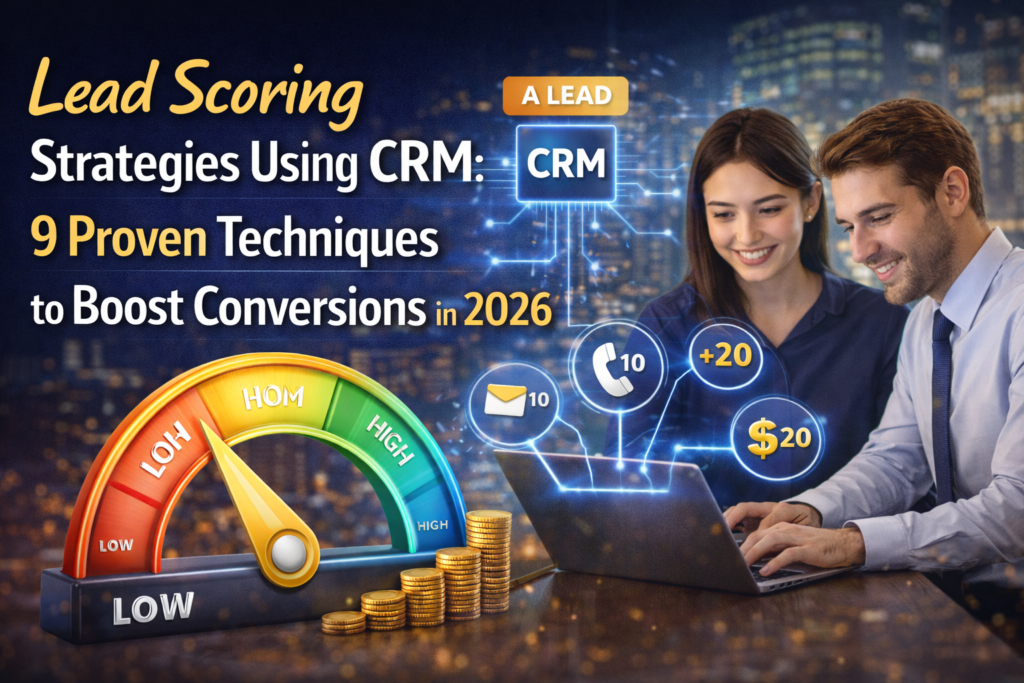
Lead scoring helps businesses rank prospects based on their likelihood to convert. By leveraging CRM tools, companies can automate this process, focus on high-value leads, and significantly improve sales efficiency.
In this blog, we’ll explore what lead scoring is, why it matters, and the most effective strategies to implement using CRM.
What is Lead Scoring?
Lead scoring is the process of assigning values (scores) to leads based on their behavior, engagement, and demographic data.
Common Criteria:
- Website visits
- Email engagement
- Job role or industry
- Purchase intent signals
The higher the score, the more likely the lead is to convert.
For a deeper understanding, check out this guide:
👉 https://blog.hubspot.com/sales/lead-scoring
Why Lead Scoring is Essential
Without lead scoring, sales teams often:
- Waste time on low-quality leads
- Miss high-potential opportunities
- Struggle with prioritization
Benefits of Lead Scoring:
- Improved conversion rates
- Better alignment between sales and marketing
- Faster sales cycles
- Higher ROI
According to Salesforce, businesses using CRM-based lead scoring see significant improvements in sales productivity:
👉 https://www.salesforce.com/products/crm/lead-management/
How CRM Enhances Lead Scoring
CRM systems automate and refine lead scoring by:
- Collecting real-time data
- Tracking customer interactions
- Applying scoring rules automatically
- Updating scores dynamically
Popular CRM platforms like Salesforce, HubSpot, and Zoho offer built-in lead scoring features.
9 Proven Lead Scoring Strategies Using CRM
1. Demographic-Based Scoring
Assign scores based on who the lead is.
Examples:
- Job title (CEO, Manager)
- Company size
- Industry relevance
Why it works:
Helps identify whether the lead fits your ideal customer profile (ICP).
2. Behavioral Scoring
Track what leads do.
Actions to score:
- Website visits
- Page views (pricing page = high intent)
- Content downloads
Impact:
Behavior often signals stronger buying intent than demographics.
3. Email Engagement Scoring
Measure how leads interact with emails.
Scoring actions:
- Open emails
- Click links
- Reply to messages
Pro Tip:
High engagement = higher conversion probability.
4. Lead Source Scoring
Not all sources perform equally.
Examples:
- Organic search → medium score
- Paid ads → variable
- Referrals → high score
Analyze which channels bring the best leads and assign scores accordingly.
5. Time-Based Scoring (Recency)
Recent activity matters more than old activity.
Example:
- Visited website today → high score
- Last interaction 3 months ago → low score
CRM systems automatically adjust scores based on recency.
6. Negative Scoring
Not all actions are positive.
Examples:
- Unsubscribing from emails
- Inactive for long periods
- Irrelevant job roles
Benefit:
Helps filter out unqualified leads.
7. Engagement Across Multiple Channels
Modern buyers interact across platforms:
- Website
- Social media
- Ads
CRM integrates all touchpoints to provide a unified score.
Learn more about omnichannel strategies:
👉 https://www.gartner.com/en/insights/customer-experience
8. Predictive Lead Scoring (AI-Based)
Advanced CRM systems use AI to predict conversion likelihood.
How it works:
- Analyzes historical data
- Identifies patterns
- Assigns scores automatically
Tools offering this:
- Salesforce Einstein
- HubSpot Predictive Scoring
Result: More accurate and scalable scoring.
9. Sales Feedback Loop
Your sales team knows best.
Strategy:
- Collect feedback from sales reps
- Adjust scoring rules
- Continuously optimize
Outcome: Better alignment and improved results.
Lead Scoring Model Example
Here’s a simple scoring model:
| Criteria | Action | Score |
|---|---|---|
| Job Title | Manager or above | +10 |
| Website Visit | Pricing page | +15 |
| Email Click | Yes | +5 |
| Demo Request | Yes | +20 |
| Inactive | 30+ days | -10 |
Total Score Interpretation:
- 0–20 → Cold lead
- 21–50 → Warm lead
- 51+ → Hot lead
Best Practices for Effective Lead Scoring
✅ Keep It Simple Initially
Start with basic rules and refine over time.
✅ Align Sales and Marketing
Both teams should agree on scoring criteria.
✅ Use Data, Not Assumptions
Base scores on real behavior and analytics.
✅ Regularly Update Scoring Models
Customer behavior evolves—your model should too.
Common Mistakes to Avoid
- Overcomplicating scoring models
- Ignoring negative signals
- Not updating scores dynamically
- Lack of CRM integration
- No feedback from sales team
Future Trends in Lead Scoring
🔮 What’s Coming Next:
- AI-driven hyper-personalization
- Real-time behavioral tracking
- Integration with intent data platforms
- Automated decision-making
Lead scoring is evolving from rule-based systems to intelligent, predictive engines.
Conclusion
Lead Scoring Strategies using CRM are essential for modern businesses aiming to increase efficiency and conversions.
By prioritizing high-quality leads, automating processes, and leveraging data-driven insights, companies can:
- Close deals faster
- Improve sales productivity
- Maximize ROI
The key is to start simple, continuously optimize, and align your teams around a shared strategy.
Final Takeaway
If you want to scale your business globally, implementing effective lead scoring strategies using CRM is not optional—it’s a necessity.
Focus on the right leads, at the right time, with the right approach—and watch your conversions grow.
Protect client trust and ensure POPIA compliance. Discover why a secure Banking CRM South Africa is the essential foundation for modern financial institutions.
