Navigating DIFC and ADGM regulations? Discover the most secure CRM for Financial Services UAE firms use to manage client data and stay audit-ready in 2026.
Table of Contents
If you’ve spent any time in the high-stakes world of wealth management or fintech in Dubai or Abu Dhabi, you know that “data” isn’t just a buzzword. It’s a liability. One slip-up with a client’s KYC document or a stray email containing sensitive portfolio data, and you aren’t just looking at a lost client—you’re looking at a massive fine from the DFSA or the FSRA. In the Emirates, the financial sector moves with a speed and opulence that’s hard to match anywhere else, but the regulatory iron curtain is just as thick.
I’ve sat in rooms with compliance officers who treat their databases like Fort Knox. They don’t care about “cool” social media integrations or flashy sales bells and whistles. They care about data residency, encryption, and the “right to be forgotten.” Finding a CRM for Financial Services UAE professionals can actually bet their careers on is a challenge because the standard global players don’t always play by the local rules. You need a system that understands the heartbeat of a DIFC firm while keeping the regulators happy.
Why UAE Financial Regulations Change the CRM Game
The UAE has rapidly evolved into a global financial powerhouse, but with that prestige comes a heavy dose of oversight. Whether you are operating within the Dubai International Financial Centre (DIFC) or the Abu Dhabi Global Market (ADGM), the rules around data privacy are non-negotiable. A standard, off-the-shelf system often fails to account for the specific UAE Data Protection Laws that mandate how personal information is stored and moved.
When you’re hunting for a CRM for Financial Services UAE firms can trust, the first question isn’t “What’s the price?” It’s “Where is the data stored?” The trend in 2026 is a move toward localized cloud hosting or hybrid models. If your CRM provider can’t guarantee that sensitive financial data stays within the UAE’s borders when required, your compliance team will kill the project before the first demo is over.
The Pillars of a Compliant Financial CRM
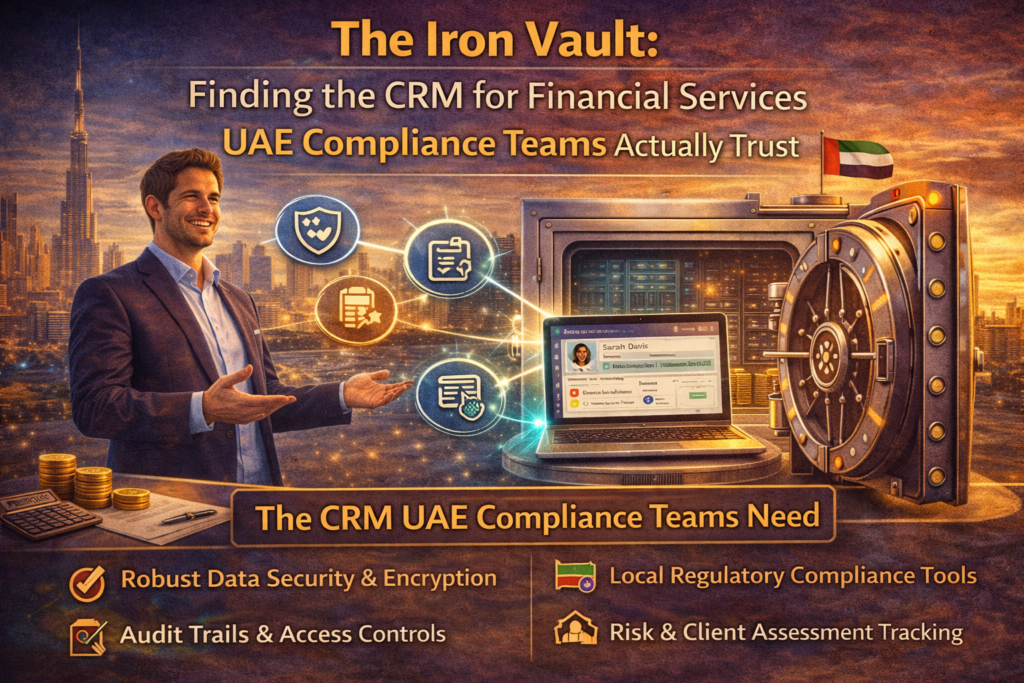
You need a system that does more than just track phone numbers. For a wealth manager or an investment banker, the CRM is the nerve center of the entire relationship. Here are the “must-haves” for a CRM for Financial Services UAE implementation to survive an audit.
1. Robust KYC and AML Integration
In this region, Know Your Customer (KYC) and Anti-Money Laundering (AML) checks are the bread and butter of daily operations. A professional CRM for Financial Services UAE setup should automate these workflows. It should flag expired Emirates IDs and passport copies months in advance. If your brokers are manually checking expiry dates on a spreadsheet, you are inviting a disaster.
2. Granular Access Controls
Not everyone in the office needs to see a High-Net-Worth Individual’s (HNWI) total asset allocation. The best CRM for Financial Services UAE platforms allow for “need-to-know” access. You should be able to lock down specific fields—like bank account numbers or private equity holdings—so they are only visible to the primary relationship manager and the compliance head.
3. Comprehensive Audit Trails
If the regulator knocks on your door in the ADGM, you need to be able to show every single person who touched a client record. A secure CRM for Financial Services UAE keeps a digital fingerprint of every edit, view, and export. This transparency isn’t just about catching mistakes; it’s about proving that your firm operates with total integrity.
Navigating Data Residency in the Emirates
The push for “sovereign clouds” is real. Major players like Microsoft and Oracle have established data centers in the UAE, which has been a lifesaver for the industry. When choosing your CRM for Financial Services UAE, you must verify that your instance is hosted locally.
This isn’t just a technicality. It’s about “Jurisdictional Safety.” If a legal dispute arises, having your data stored in a UAE-based data center ensures that local laws apply. According to the latest insights on Wikipedia’s Economy of the United Arab Emirates page, the nation’s focus on digital infrastructure has made it a leader in secure data handling. Your CRM choice should reflect that national priority.
Managing the HNWI Relationship at Scale
In Dubai, “service” is an art form. Your clients expect you to remember their favorite coffee, their children’s birthdays, and their specific risk tolerance for crypto-assets. A CRM for Financial Services UAE needs to be a “memory bank” that empowers your relationship managers to provide that concierge-level touch.
But here is the catch: you have to do it without being “creepy” or violating privacy. The software should help you segment your audience so that you’re only sending relevant investment opportunities. If you blast a conservative retiree with a high-risk venture capital pitch, you’ve failed. A smart CRM for Financial Services UAE uses data to refine the “Ideal Investor Profile,” ensuring your marketing is as precise as a surgeon’s scalpel.
The Importance of Mobile Security for Field Teams
Let’s be honest: business in the UAE happens in airport lounges, five-star hotel lobbies, and private villas. Your team is rarely tethered to a desk. Consequently, the mobile version of your CRM for Financial Services UAE must be just as secure as the desktop version.
We’re talking about biometric logins, remote-wipe capabilities, and encrypted caching. If a relationship manager loses their phone at a mall in Abu Dhabi, you need to be able to kill the data on that device in seconds. This level of cybersecurity is what keeps compliance officers from losing sleep.
Automating the Onboarding Friction Away
The biggest bottleneck in financial services is onboarding. The mountain of paperwork required to open a brokerage account or a private bank line is enough to frustrate any client. A top-tier CRM for Financial Services UAE will have a digital onboarding portal.
Imagine a world where the client uploads their documents to a secure, branded portal that feeds directly into the CRM. The system then automatically runs the background checks and notifies the compliance team for approval. This reduces “time-to-revenue” and provides a sleek, modern customer experience that matches the luxury brands your clients are used to.
Integration with Global Financial Tech
Your CRM shouldn’t be a lonely island. To get the best ROI, your CRM for Financial Services UAE must integrate with your core banking system, your trading platforms, and your portfolio management software.
You want a 360-degree view. When a client calls, the broker should see their current portfolio value, their latest trades, and any pending compliance tasks on a single screen. This is the level of workflow automation that allows a firm to scale without ballooning its headcount. Insights from the Dubai Financial Services Authority (DFSA) suggest that firms utilizing integrated RegTech see significantly fewer compliance breaches.
Training for a “Compliance-First” Culture
The best software in the world is useless if your team finds it too difficult to use. I’ve seen firms spend millions on a CRM for Financial Services UAE only to have their bankers go back to using “Notes” on their personal phones because the CRM was too clunky.
Adoption is the only metric that matters. When you roll out a new system, the training shouldn’t just be about “how to click buttons.” It should be about “how this protects the firm and your commission.” If the team understands that the CRM is their shield against legal trouble, they will embrace it.
FAQ Section
1. Does a CRM for Financial Services UAE have to be hosted locally? While not every single piece of data is mandated to be local, the trend and best practice for compliance with UAE Data Protection laws is to use locally hosted cloud providers. This significantly simplifies audits and ensures you are meeting the expectations of the DIFC and ADGM regulators.
2. How long does it take to implement a secure CRM for Financial Services UAE? A basic implementation can take 3 to 4 months, but for a fully integrated system with custom KYC/AML workflows and core banking connections, you should plan for 6 to 9 months. The testing and compliance “sign-off” usually take the most time.
3. Can a CRM help with FATCA and CRS reporting? Yes, a specialized CRM for Financial Services UAE can be configured to track the necessary data points for Foreign Account Tax Compliance Act (FATCA) and Common Reporting Standard (CRS) requirements, making your annual reporting much less painful.
4. Is WhatsApp communication allowed in a financial CRM? It is common in the UAE, but it must be managed. Many firms use a CRM for Financial Services UAE that integrates with official WhatsApp Business APIs. This allows for client convenience while ensuring all communications are archived and monitored for compliance purposes.
5. What is the average cost of an enterprise-grade financial CRM? For a secure, compliant system in the UAE, you are likely looking at $150 to $300 per user per month, plus significant initial setup and integration fees. However, the cost of a single regulatory fine often far exceeds the cost of the software.
6. How do I migrate my existing client data securely? Data migration is the most sensitive part of the process. You should use encrypted transfer methods and perform a “data scrub” before importing. Most providers of a CRM for Financial Services UAE will offer a dedicated migration consultant to ensure no data is leaked during the move.
Conclusion
In the shimmering skyline of the UAE’s financial districts, trust is the only currency that never devalues. Your choice of a CRM for Financial Services UAE is a statement about how much you value that trust. It’s not just about managing leads; it’s about safeguarding a legacy.
