Scaling a hotel in Dubai or Abu Dhabi? Discover how a CRM for Tourism and Hospitality drives direct bookings, guest loyalty, and high-value revenue in 2026.
Table of Contents
If you’ve ever walked through the lobby of a five-star hotel in Downtown Dubai or along the Saadiyat Island beachfront, you know that hospitality in the Emirates isn’t just a service—it’s a grand performance. We aren’t just selling a bed for the night; we are selling an aspiration. But behind the shimmering gold leaf and the world-class concierge service lies a brutal reality. The competition is relentless, and the cost of acquiring a new guest through third-party booking sites is eating into margins like never before.
I’ve talked to dozens of general managers across the UAE, and the sentiment is always the same: “We have the data, but we aren’t using it.” This is precisely why a specialized CRM for Tourism and Hospitality is no longer a luxury for the big chains; it’s a survival tool for every independent boutique and luxury resort in the region. To win in 2026, you have to stop treating guests like a confirmation number and start treating them like a relationship that exists long before they check in and long after they leave.
The UAE Market: A Unique Hospitality Beast
The UAE is a global crossroads. You have the “bleisure” traveler in DIFC, the massive family groups visiting during the Dubai Shopping Festival, and the luxury seekers looking for a quiet desert escape. Each of these guests has a vastly different set of expectations. If you send the same generic summer promotion to a corporate traveler that you send to a family of six, you’re essentially shouting into the wind.
A professional CRM for Tourism and Hospitality allows you to slice through that noise. It gives you the “digital memory” to know that a guest prefers a high-floor room away from the elevator, or that they always book a spa treatment on their second day. In a market where every hotel offers “luxury,” the one that remembers the small, human details is the one that secures the return visit.
Moving Away from the OTA Trap
Let’s be honest: Online Travel Agencies (OTAs) are a double-edged sword. They fill rooms, but they take a massive bite out of your profit and, more importantly, they own the guest relationship. When a guest books through a third party, you often get a masked email and zero insight into their preferences.
By implementing a CRM for Tourism and Hospitality, your goal is to “capture” that guest for the future. Once they are on-site, every interaction should feed back into your system. Did they visit the rooftop bar? Did they ask for extra towels? This data allows you to create a “Loyalty Loop.” The next time they think about visiting Abu Dhabi, your personalized direct-booking offer—tailored exactly to their past behavior—will be much more enticing than a generic listing on a global search engine.
Personalization: The Heart of the Guest Journey
I’m a firm believer that personalization is the new gold standard in the Emirates. We are past the era of just putting a name in an email subject line. True personalization is about predictive analytics. It’s about knowing that a guest typically visits during Ramadan and proactively reaching out with a specialized Iftar package three months in advance.
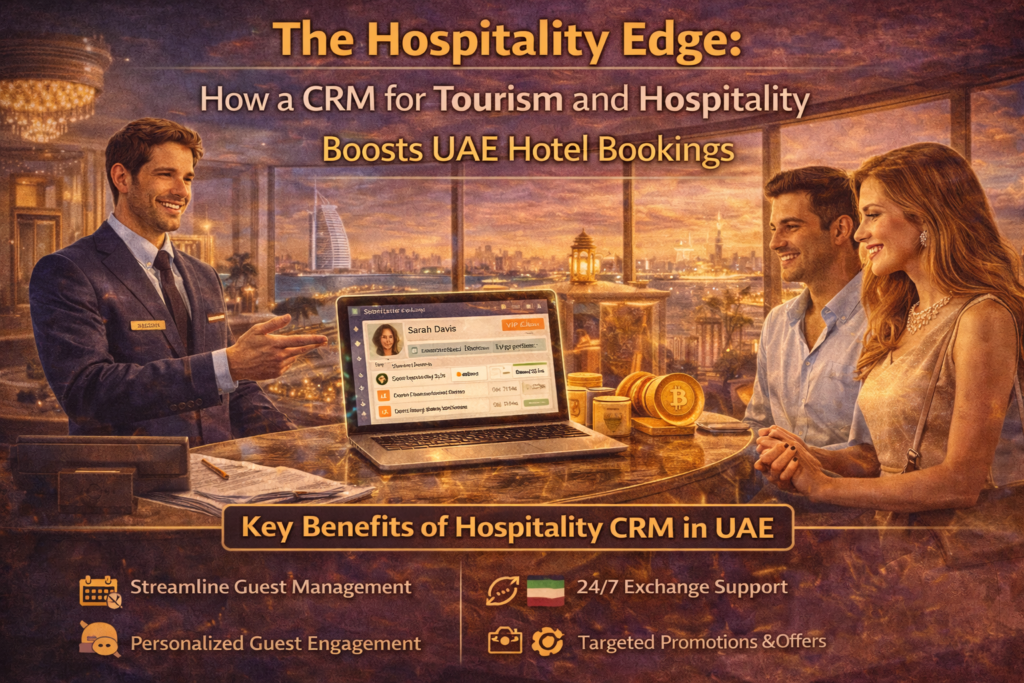
When your CRM for Tourism and Hospitality is synced with your Property Management System (PMS), you create a seamless flow of information. Your front desk staff can see a guest’s total “Value Score” the moment they walk in. If a “High-Value” regular is checking in, the system can trigger an automatic room upgrade or a personalized welcome note from the manager. This isn’t just “good service”; it’s a strategic move to increase customer lifetime value.
Leveraging Data for Better Event Management
The UAE is a hub for massive global events, from the Abu Dhabi Grand Prix to the various trade summits at DWTC. Managing the influx of guests during these windows is a logistical mountain. A CRM for Tourism and Hospitality helps you manage these “Peak Seasons” with surgical precision.
You can segment your database to see who visited during previous events and target them with “Early Bird” exclusives. This ensures your high-value rooms are filled with direct bookings before the OTAs even get a look in. According to the latest industry standards on Wikipedia’s Hospitality Management page, the integration of CRM technology into the guest lifecycle is the primary driver of revenue growth for modern hotels.
Building a “VIP” Culture
In a region that loves a “Gold Tier” or a “Platinum Club,” your CRM for Tourism and Hospitality should be the engine behind your loyalty program. But forget about plastic cards and point systems that no one understands. Think about “Experiential Loyalty.”
- Priority Access: Use the CRM to flag regulars for early check-ins.
- Curated Experiences: If the data shows a guest loves golf, send them a complimentary pass to a local course.
- Birthday Surprises: A small gesture, logged in the CRM, can turn a guest into a brand advocate for life.
Streamlining the Pre-Arrival Experience
The “Experience” starts the moment the booking is confirmed. If a guest hears nothing from you until they reach the check-in desk, you’ve missed a massive opportunity. A CRM for Tourism and Hospitality allows for automated, but deeply personal, pre-arrival sequences.
Ask them about their pillow preferences. Ask if they need a car from the airport. Not only does this improve the user experience, but it also provides a natural opening for up-selling. If you know a guest is visiting for an anniversary, your CRM can trigger a suggestion for a private beach dinner. This “soft sell” is much more effective because it feels like a helpful suggestion rather than a sales pitch.
Enhancing F&B and Ancillary Revenue
Hotel revenue isn’t just about RevPAR (Revenue Per Available Room). In the UAE, the F&B (Food and Beverage) scene is a major part of the business model. Your CRM for Tourism and Hospitality should track more than just room stays; it should track dining habits.
If a local resident frequently visits your Saturday brunch but has never stayed in a room, they are a prime target for a “Staycation” offer. Conversely, if a guest stays in your hotel but never dines at your signature restaurant, your CRM can offer them a “First-Time Diner” discount. This cross-pollination of data is what turns a one-dimensional hotel into a multi-dimensional revenue machine. Insights from the Dubai Department of Economy and Tourism show that high-performing venues are those that treat every visitor as a potential multi-channel customer.
The Role of Social Listening and Reputation
In the age of TripAdvisor and Instagram, your reputation is public property. A robust CRM for Tourism and Hospitality often includes “Social Listening” tools. It allows you to see what people are saying about your property in real-time.
If a guest posts a stunning photo of your pool on Instagram, your CRM should help your team identify them (if they are a guest) and send a quick “Thanks for sharing!” message. If they post a complaint, you should know about it before they even check out, giving you the chance to “Service Recover” on the spot. This proactive approach to online reputation management is the difference between a four-star and a five-star rating.
Training Your Staff for a Data-Driven Culture
I’ve seen some old-school concierges worry that a CRM will make their job “robotic.” I actually think the opposite is true. When the CRM for Tourism and Hospitality handles the “remembering,” the human is free to be more present.
The software doesn’t replace the warm greeting or the expert local advice; it just ensures the advice is relevant. Training your team to use a CRM is about empowering them. When a waiter can say, “Welcome back, Mr. Al-Sayed, would you like your usual sparkling water with lime?” that waiter just became a master of hospitality. Adoption of a CRM for Tourism and Hospitality is about building a culture where data is used to fuel human connection.
Data Security in a Global Hub
Operating in the UAE means dealing with international guests and strict data privacy laws. As you build out your CRM for Tourism and Hospitality strategy, you must prioritize cybersecurity. Guests are trusting you with their passport copies, credit card details, and personal preferences.
Ensure your system is compliant with local UAE data residency laws and international standards like GDPR. A “Privacy-First” approach is not just a legal requirement; it’s a trust builder. When guests know their data is safe, they are much more willing to share the details that allow you to provide a better experience.
FAQ Section
1. Is a CRM for Tourism and Hospitality different from a standard CRM? Yes. A standard CRM is built for sales cycles and lead pipelines. A CRM for Tourism and Hospitality is built for guest cycles, room preferences, F&B habits, and loyalty. It integrates deeply with hotel-specific software like PMS and POS systems.
2. Can a small boutique hotel in the UAE afford this technology? Absolutely. Many modern, cloud-based CRM for Tourism and Hospitality providers offer tiered pricing. The cost is often far lower than the commission you pay to a single OTA for a few bookings, making the ROI very easy to justify.
3. Does the CRM help with corporate and MICE bookings? Definitely. The system can track corporate contracts, event history, and group preferences, making it much easier to manage large-scale “Meetings, Incentives, Conferences, and Exhibitions” (MICE) business which is a huge part of the UAE market.
4. How long does it take to see an increase in hotel bookings? Most hotels see a rise in direct bookings within 3 to 6 months. It takes a little time to build up your database and refine your automated “nurture” sequences, but the impact on your bottom line is usually felt very quickly.
5. How do we handle guest data from different countries? A professional CRM for Tourism and Hospitality will have built-in tools for managing different privacy regulations and languages, ensuring that your outreach is legal and respectful regardless of where your guest is from.
6. Can a CRM help with seasonal staffing issues? While it doesn’t hire staff, it makes onboarding much faster. A new team member can look at a guest’s profile in the CRM for Tourism and Hospitality and immediately know their history, allowing them to provide a high level of service from day one.
Conclusion
At the end of the day, the UAE is a place that celebrates the “extraordinary.” People don’t come here for the average; they come for the best. Using a CRM for Tourism and Hospitality is simply the modern way to deliver that extraordinary level of care at scale.
